
Dinosaurs have a special way of getting children’s attention. A preschooler who isn’t interested in drawing a house or coloring a flower may suddenly want to grab every green crayon in the box after seeing a picture of a T. rex.
That’s what makes dinosaur coloring pages for preschoolers such a useful activity. They combine something children already find exciting with a simple creative task that can be done at the kitchen table, in a classroom, or during a quiet afternoon at home.
Printable dinosaur pages are also convenient for parents. You can find a suitable design, open the PDF on a computer or phone, print a few pages, and put them in front of your child with some crayons.
You don’t need to create a complicated activity around it.
A simple dinosaur picture can be enough.
This guide explains how to choose age-appropriate dinosaur coloring pages, how to print them as PDFs, different dinosaur themes to try, and several easy ways to turn coloring time into a fun learning activity.
Why Preschoolers Love Dinosaur Coloring Pages
Dinosaurs are naturally imaginative subjects.
Children can look at a dinosaur and immediately start asking questions:
“How big was it?”
“What did it eat?”
“Could it fly?”
“Why is it called a T. rex?”
You don’t have to answer every question with a detailed scientific explanation. Even a short conversation can make the coloring activity more interesting.
For example, if your child is coloring a Triceratops, you might point to its three horns and say:
“This dinosaur has three horns.”
Then let your child decide what color the dinosaur should be.
The combination of coloring and conversation makes the activity feel more interactive without turning it into a formal lesson.
What Makes a Good Dinosaur Coloring Page for Preschoolers?
A dinosaur coloring page can look great on a screen but still be frustrating for a young child.
When choosing printable pages, I recommend looking for a few simple features.
Large Dinosaur Shapes
Preschoolers usually have an easier time coloring large areas.
A dinosaur with a big body, large legs, and clear spaces is more practical than an illustration packed with tiny scales.
Thick Black Outlines
Bold outlines make the different parts of the dinosaur easier to identify.
They also give children a clear visual boundary while they are learning to control crayons and pencils.
Friendly Cartoon Designs
Not every dinosaur page needs to look scary.
For younger children, cute cartoon dinosaurs with friendly expressions can be a better choice.
Look for designs featuring:
- Smiling dinosaurs
- Big eyes
- Simple faces
- Short backgrounds
- Large body shapes
Simple Backgrounds
A dinosaur standing on its own can be easier for a preschooler than a detailed prehistoric landscape.
Once your child becomes comfortable coloring, you can introduce pages with trees, rocks, clouds, volcanoes, and other simple details.
Popular Dinosaur Coloring Pages to Try
You don’t have to stick with one dinosaur.
A small collection can introduce children to several different dinosaur shapes.
T. Rex Coloring Pages
The Tyrannosaurus rex is probably one of the first dinosaurs many children recognize.
A simple cartoon T. rex can have:
- Large teeth
- Short arms
- Strong legs
- A long tail
- A large head
Ask your child to find each body part while coloring.
You can also explain that “T. rex” is a shorter way of saying Tyrannosaurus rex.
Triceratops Coloring Pages
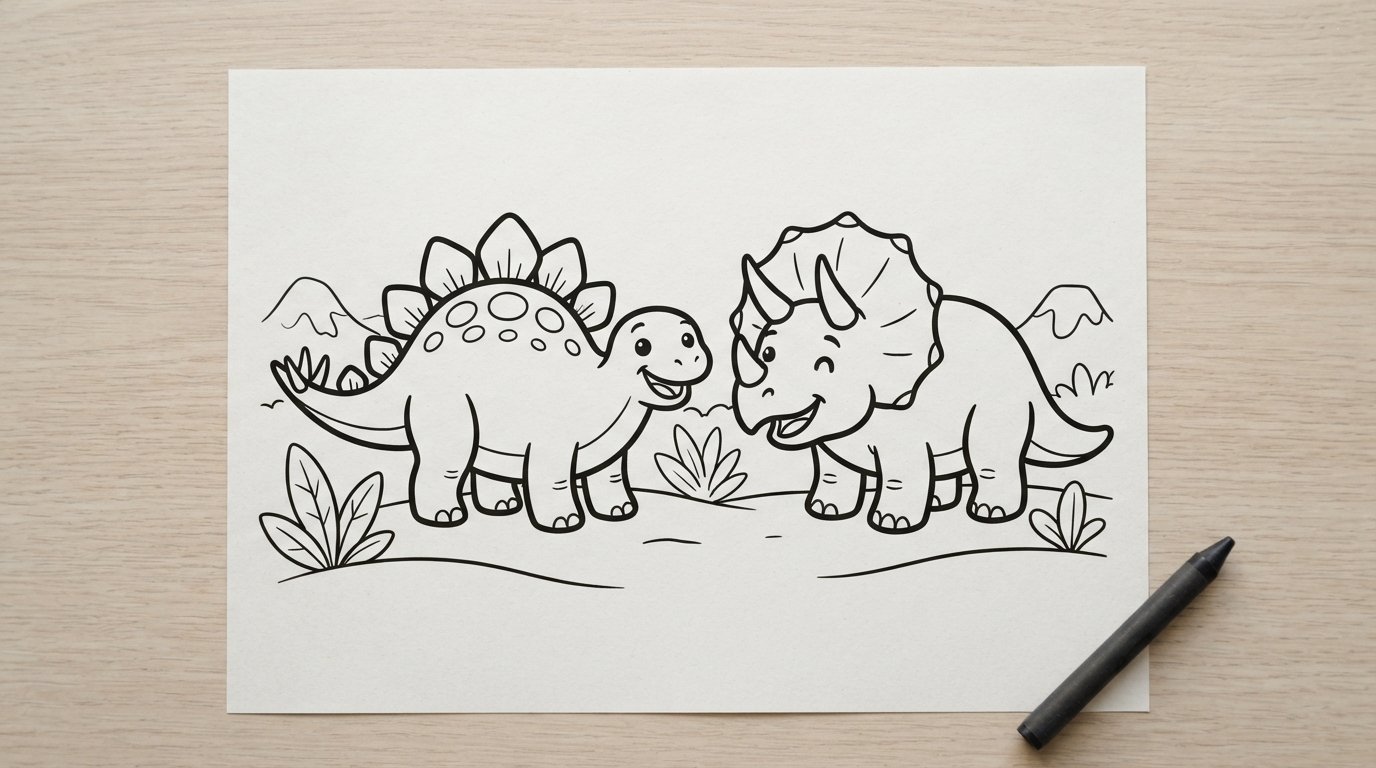
Triceratops is an excellent choice for preschoolers because its three horns make it easy to recognize.
You can ask:
“How many horns does it have?”
Let your child count them.
This turns a simple coloring page into a quick counting activity.
Stegosaurus Coloring Pages
Stegosaurus is another fun dinosaur for coloring because of the large plates along its back.
Children can color every plate differently if they want.
You can ask:
“Should all the plates be the same color?”
There’s no wrong creative answer.
Brachiosaurus Coloring Pages
A Brachiosaurus page gives children something different because of its long neck.
You can talk about how the dinosaur’s long neck makes it look very tall.
A simple picture of the dinosaur standing beside trees can also introduce the idea of size.
Pterodactyl-Style Flying Reptile Pages
Children often group every prehistoric flying creature under “dinosaur,” although flying reptiles such as pterosaurs were not technically dinosaurs.
For preschool activities, you can still introduce a simple flying prehistoric creature page and explain the difference in an age-appropriate way if your child is interested.
The important thing is keeping the explanation simple.
How to Print Dinosaur Coloring Pages as a PDF
PDF is one of the easiest formats for printable coloring pages because it generally keeps the page layout consistent.
Here’s a simple process.
Step 1: Find an Appropriate Printable
Choose a dinosaur design suitable for your child’s age.
Check the image before downloading it.
A preschool page should generally have large spaces and clear outlines.
Step 2: Open the PDF
You can open the file on:
- Windows PC
- Mac
- Chromebook
- Android phone
- iPhone
- Tablet
Most modern devices can open PDF files without much setup.
Step 3: Check the Preview
Before printing, look at the preview.
Make sure the dinosaur isn’t cut off.
If necessary, choose a setting such as Fit to Page or Scale to Fit.
Step 4: Choose Black-and-White
Most coloring pages only require black outlines.
Black-and-white printing is usually the simplest option and can reduce color ink usage.
Step 5: Print a Small Batch
Instead of immediately printing every dinosaur page you find, start with two or three.
See which designs your child enjoys.
You can always print additional pages later.
What Paper Should You Use?
For basic crayon coloring, ordinary printer paper is usually enough.
If your preschooler presses very hard with crayons, slightly heavier paper can be more comfortable.
If you’re using markers, thicker paper can help reduce ink bleeding.
You don’t need expensive professional art paper for ordinary children’s coloring.
A standard home printer and regular paper can work perfectly well for this activity.
Don’t Worry About Realistic Dinosaur Colors
This is one of the easiest ways to keep coloring fun.
A preschooler doesn’t need to color a dinosaur according to what they think it “should” look like.
Let them use:
- Purple
- Blue
- Green
- Orange
- Pink
- Yellow
- Brown
If they want a rainbow dinosaur, let them make one.
You can even ask:
“Why did you choose blue?”
The answer may be as simple as “because blue is my favorite.”
That’s perfectly fine.
A Mistake I Would Avoid: Correcting Every Color
It’s tempting to say:
“Dinosaurs weren’t pink.”
But that isn’t necessary during a creative activity.
We don’t know the exact colors of many extinct dinosaurs, and a coloring page is an imaginative activity anyway.
If your child wants a bright pink T. rex, there’s no need to change it.
Instead, you can separate creativity from factual learning.
For example:
“Your T. rex is pink! Scientists don’t know exactly what every dinosaur looked like, so your picture can be your own version.”
That keeps the activity both fun and informative.
Turn Dinosaur Coloring Into a Learning Game
You can add simple learning activities without making the child feel like they’re doing schoolwork.
Count the Dinosaurs
If a page contains several dinosaurs, ask your child to count them.
“How many dinosaurs are there?”
Start with small numbers.
Identify Body Parts
Ask your child to point to:
- Head
- Tail
- Legs
- Feet
- Eyes
- Mouth
This works particularly well with simple cartoon designs.
Compare Sizes
Print a small dinosaur and a large dinosaur.
Ask:
“Which one is bigger?”
“Which one is smaller?”
You can introduce simple comparison words such as big, small, tall, and long.
Practice Colors
Place several crayons on the table and ask:
“Which color would you like?”
You can also ask your child to find a specific color.
“Can you find the green crayon?”
Make a Dinosaur Story
This is one of my favorite ways to extend the activity.
After your child finishes coloring a dinosaur, ask them to give it a name.
Maybe it becomes:
“Tommy the T. Rex.”
Then ask:
“Where does Tommy live?”
“What does Tommy eat?”
“Does Tommy have dinosaur friends?”
You may end up with a completely imaginary story.
That’s fine.
The coloring page becomes the starting point for storytelling.
Create a Dinosaur Coloring Book
If your child really enjoys dinosaurs, turn several printable pages into a homemade coloring book.
Print around 10 pages and arrange them in a simple order.
You could include:
- T. Rex
- Triceratops
- Stegosaurus
- Brachiosaurus
- Ankylosaurus
- Velociraptor
- Diplodocus
- A dinosaur family
- Dinosaur eggs
- A prehistoric landscape
Put the pages into a folder or bind them with simple binder rings.
Let your child decorate the cover.
You could write:
My Dinosaur Coloring Book
and leave space underneath for your child’s name.
Add Dinosaur Stickers
If you already have dinosaur stickers at home, they can make a nice addition.
For example, after coloring a page, your child can place a sticker beside the dinosaur.
You can also create a simple scene:
- Dinosaur
- Tree
- Sun
- Clouds
- Rocks
This allows children to build their own prehistoric environment.
Just make sure any small accessories are age-appropriate and supervised for younger children.
Use Dinosaur Toys With Coloring Pages
If your child already has plastic dinosaur toys, bring a few to the table.
Place a Triceratops toy next to a Triceratops coloring page.
Ask:
“Do these look similar?”
Your child can compare the horns, body, legs, and tail.
This can make the printable activity feel more connected to their existing toys.
Dinosaur Coloring for Different Preschool Ages
Children develop at different speeds, but you can adjust the complexity of the pages.
Younger Preschoolers
Choose pages with:
- One dinosaur
- Large spaces
- Thick outlines
- Minimal background
- Simple shapes
Scribbling outside the lines is completely normal.
Older Preschoolers
You can introduce:
- Multiple dinosaurs
- Dinosaur scenes
- Simple landscapes
- Dinosaur eggs
- Volcanoes
- Trees and rocks
- Basic counting activities
You can also encourage the child to draw something around the dinosaur after finishing the main picture.
Create a Dinosaur-Themed Activity Tray
A small activity tray can make preparation easier.
You could include:
- Dinosaur coloring pages
- Crayons
- Colored pencils
- Washable markers
- Dinosaur stickers
- Blank paper
- A few dinosaur toys
Keep everything together in one container.
When your child wants to color, you can simply take out the tray.
There’s no need to search through drawers for supplies.
Keep the Number of Pages Small
Free printables can create a funny problem: because they’re free, it’s easy to print far more than your child will actually use.
I recommend starting with three or four pages.
For example:
Page 1: T. Rex
Page 2: Triceratops
Page 3: Stegosaurus
Page 4: Dinosaur scene
Then see which one your child prefers.
If the T. rex gets colored immediately while the other pages remain untouched, you have learned something about their current interest.
Let the Child Stop When They Want
A coloring page doesn’t need to be finished in one sitting.
A preschooler might color the head and then decide they want to play with something else.
That’s okay.
You can keep the unfinished page in a folder and bring it back another day.
Trying to force a child to complete every page can make a fun activity feel like a chore.
Display the Finished Dinosaur Artwork
Children often enjoy seeing their artwork displayed.
You can put finished pages:
- On the refrigerator
- On a bedroom wall
- In a children’s art folder
- On a notice board
- Inside a scrapbook
You don’t need to keep every page forever.
Choose a few favorites and let your child decide which ones are special.
Use Dinosaur Pages for Screen-Free Time
One useful thing about printable coloring pages is that the screen is only needed during preparation.
You might use your laptop or phone to find and print the PDF.
After that, put the device away and let your child work with physical materials.
For example, you could prepare a few dinosaur pages before breakfast and leave them on the activity table for later.
This makes the activity easy to start without another round of searching.
Safety Tips for Preschool Coloring
Choose crayons, markers, and other art materials according to the manufacturer’s age recommendations.
Washable supplies are often easier for parents because accidental marks on hands, clothes, tables, and walls can be cleaned more easily.
Young children should be supervised around art supplies, especially if they still put objects in their mouths.
Avoid small accessories or craft pieces that could present a choking risk.
A simple coloring activity should remain a safe and comfortable experience.
Frequently Asked Questions
Where can I get free dinosaur coloring pages in PDF format?
Many children’s activity and educational websites offer printable dinosaur pages, sometimes as individual PDFs or collections. Check the website’s usage terms before downloading, sharing, or republishing the files.
What dinosaur is easiest for preschoolers to color?
T. Rex, Triceratops, Stegosaurus, and Brachiosaurus are good starting points because their body shapes are easy for children to recognize.
What paper should I use for dinosaur coloring pages?
Standard printer paper works well for crayons. Heavier paper may be preferable if your child uses markers or presses heavily while coloring.
Can I print dinosaur coloring pages from my phone?
Yes. If your printer supports wireless printing, you can often send a PDF directly from a smartphone using the printer’s app or your phone’s printing function.
Should dinosaurs always be colored green?
No. Children can choose any colors they like. Coloring is a creative activity, so there’s no need to restrict dinosaurs to realistic-looking colors.
Are dinosaur coloring pages educational?
They can support simple skills such as color recognition, counting, vocabulary, observation, storytelling, and identifying basic body parts.
A Simple Dinosaur Afternoon Activity
You don’t need a complicated plan.
Print three pages:
T. Rex
Triceratops
Stegosaurus
Put six or seven crayons on the table.
Let your child choose one page.
While they color, ask a few simple questions.
“What dinosaur is this?”
“How many legs does it have?”
“What color are you using?”
When they’re finished, ask them to give the dinosaur a name.
Then hand them a blank piece of paper and say:
“Can you draw a home for your dinosaur?”
The activity can naturally move from coloring to drawing and storytelling.
That’s often more enjoyable than trying to make the child complete a fixed worksheet.
Final Thoughts
Dinosaur coloring pages don’t need to be complicated to be useful.
A simple PDF with a friendly cartoon dinosaur, a few crayons, and a comfortable table can give a preschooler plenty of room to explore colors and imagination.
Start with large, uncomplicated designs. Let children choose their own colors, and don’t worry if their dinosaurs look nothing like the pictures in books. Add counting, storytelling, toys, or stickers only when your child seems interested.
Most importantly, don’t measure the activity by how neatly the page is colored.
Sometimes a preschooler will spend twenty minutes carefully coloring every dinosaur plate. Other times they’ll scribble across the entire page and run off to play.
Both are perfectly normal.
Print a few dinosaur pages, put the crayons within reach, and let the little artist decide what happens next.