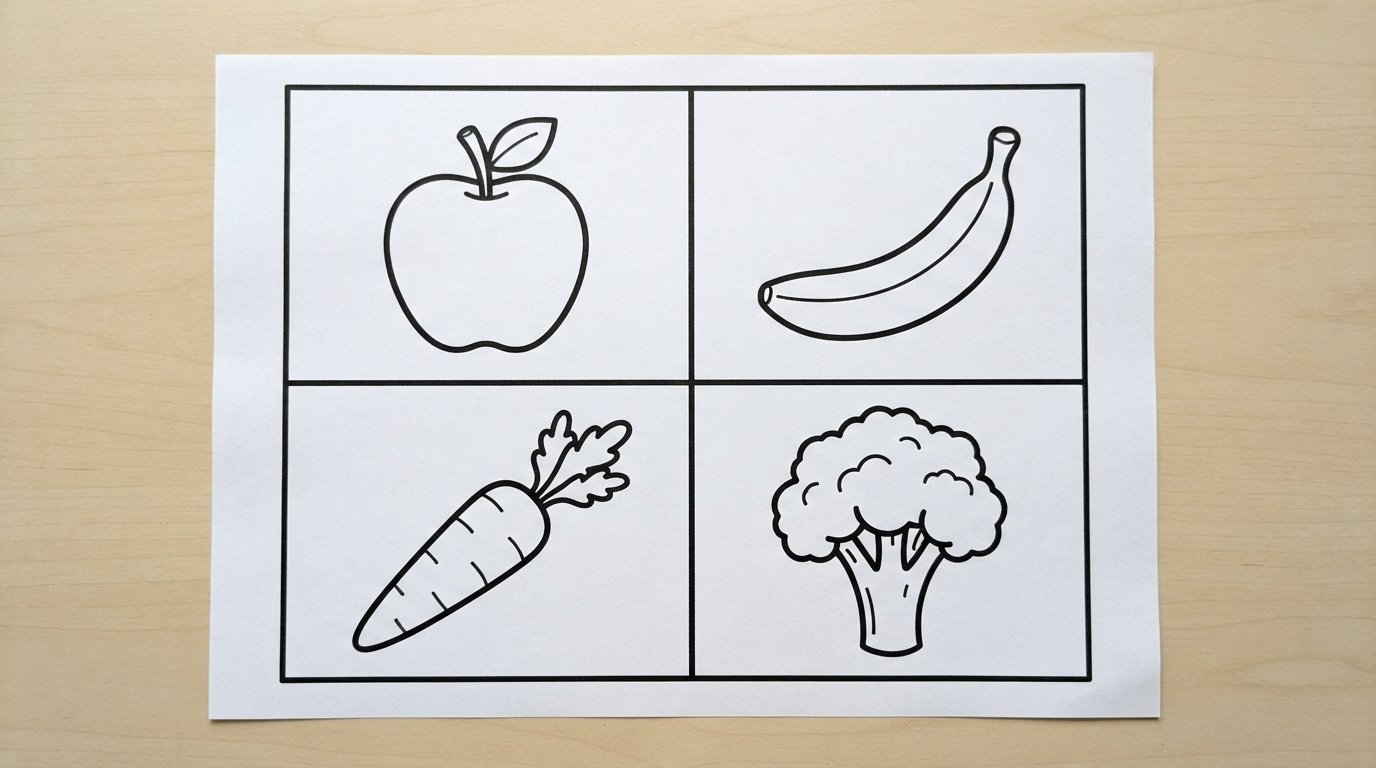

Learning the names of everyday fruits and vegetables can be much easier when children can see, say, and color the items at the same time. A simple picture of an apple with the word APPLE underneath gives a young child several ways to interact with the same piece of information.
Fruit and vegetable name identification coloring worksheets combine picture recognition, simple word exposure, and coloring into one easy activity. They can be used at home, in preschool, during quiet time, or as part of an early-learning activity folder.
You don’t need to turn the worksheet into a formal lesson. A child can color a banana yellow, hear you say “banana,” and then look at the printed word. With repetition, these small activities can help children become more familiar with common food names and printed words.
What Are Fruit and Vegetable Name Identification Worksheets?
These worksheets usually show a fruit or vegetable illustration together with its written name.
For example:
APPLE
[Picture of an apple]
The child can color the picture while an adult points to the word and says it aloud.
A worksheet might contain one large item or several simple pictures.
Common fruit examples include:
- Apple
- Banana
- Orange
- Mango
- Strawberry
- Watermelon
- Grapes
- Pineapple
- Pear
- Peach
Vegetable examples can include:
- Carrot
- Tomato
- Potato
- Corn
- Peas
- Cucumber
- Pumpkin
- Broccoli
- Onion
- Spinach
The exact selection can be adjusted for the child’s vocabulary and learning level.
Why Combine Food Names With Coloring?
Coloring gives children a hands-on way to interact with vocabulary.
Instead of simply asking:
“What is this?”
you can point to the picture and say:
“This is an APPLE.”
Then ask:
“What color should we make it?”
The child might choose red, green, or even purple.
While coloring, repeat the word naturally.
“Red apple.”
“Big apple.”
“I like apples.”
This turns a basic worksheet into a small conversation.
Start With Familiar Fruits
For younger children, begin with foods they already see at home.
An apple, banana, orange, or mango may be easier to identify than an unfamiliar vegetable.
A simple first worksheet could contain:
- Apple
- Banana
- Orange
- Mango
Use large illustrations and large printed names.
Once the child becomes comfortable with these foods, gradually introduce additional items.
Fruit Coloring Worksheet Ideas
There are several simple ways to design fruit worksheets.
1. Picture and Name
Place one large fruit illustration in the center of the page.
Underneath it, write the name in large letters.
For example:
BANANA
The child colors the banana while an adult reads the word.
2. Match the Fruit
Place several fruit pictures on one side and their names on the other.
For older preschoolers, the child can draw a line between each fruit and its name.
For younger children, simply point to the matching word together.
3. Color the Correct Fruit
Show three or four pictures and ask:
“Can you find the banana?”
After finding it, the child colors the banana.
This combines recognition with a simple coloring task.
4. Fruit Basket Page
Create a picture of a basket containing several fruits.
Label individual items with simple names.
For example:
APPLE — BANANA — PEAR — ORANGE
The child colors the basket and its contents.
Vegetable Name Identification Activities
Vegetables can be introduced in exactly the same way.
Start with familiar items such as:
- Carrot
- Potato
- Tomato
- Corn
- Peas
A carrot worksheet could show a large carrot with the word:
CARROT
Ask the child:
“What is this?”
If they don’t know, simply say:
“Carrot.”
Then let them color it.
Repeated exposure is more useful than turning the activity into a test.
Use Realistic and Simple Colors
Coloring worksheets can also introduce children to the typical colors associated with food.
For example:
- Banana — yellow
- Carrot — orange
- Broccoli — green
- Tomato — red
- Eggplant — purple
- Corn — yellow
- Cucumber — green
- Strawberry — red
But don’t require children to follow these colors.
If a child wants to color a blue banana, that’s perfectly fine during a creative coloring activity.
You can introduce the typical color without taking away the child’s choice.
“Bananas are often yellow. You can choose any color you like.”
Talk About Shapes and Textures
Food worksheets can lead to conversations beyond names.
For example:
Apple: round, smooth, crunchy
Banana: long, soft, yellow
Carrot: long, hard, orange
Watermelon: large, round, green outside
You don’t need to teach all of these details at once.
Choose one or two simple characteristics and let the child talk about what they already know.
Create a Fruit and Vegetable Vocabulary Folder
A simple folder can turn individual worksheets into a growing collection.
Create two sections:
Fruits
- Apple
- Banana
- Orange
- Mango
- Grapes
- Strawberry
Vegetables
- Carrot
- Potato
- Tomato
- Corn
- Peas
- Broccoli
Each time your child completes a worksheet, add it to the appropriate section.
Later, you can look through the folder together and revisit familiar names.
Connect Worksheets With Grocery Shopping
One of the easiest ways to reinforce food vocabulary is to connect the worksheet with real life.
Suppose your child colors a CARROT worksheet.
The next time you’re shopping, point to carrots and say:
“Look, we colored carrots yesterday.”
This creates a connection between the printed picture and a real object.
The same approach works with apples, bananas, oranges, potatoes, tomatoes, and many other foods.
Make a Simple Grocery Store Game
You can create a pretend grocery store at home.
Place a few safe, real fruits or vegetables on a table.
Give the child a worksheet or picture card.
Ask them to find the matching food.
For example:
Show the APPLE worksheet.
“Can you find the apple?”
The child picks up the apple.
Then switch to:
“Can you find the banana?”
This makes vocabulary practice active instead of requiring the child to sit at a desk the entire time.
Use Beginning Letters
For preschoolers who are starting to recognize letters, emphasize the first letter of each food.
For example:
A — Apple
B — Banana
C — Carrot
M — Mango
You can circle the first letter or print it in a larger outline.
Then say:
“Apple starts with A.”
The child doesn’t need to memorize every word immediately.
The purpose is simply to introduce connections between sounds, letters, pictures, and familiar objects.
Create Alphabet Food Coloring Pages
You can build an entire alphabet-themed collection around food.
For example:
A — Apple
B — Banana
C — Carrot
G — Grapes
M — Mango
O — Orange
P — Potato
S — Strawberry
T — Tomato
W — Watermelon
Some letters have fewer obvious everyday food examples, so there’s no need to force an entire alphabet if the resulting worksheets become unnatural.
Fruit and Vegetable Sorting Activity
After coloring several worksheets, use them for sorting.
Make two headings:
FRUITS
VEGETABLES
Place the completed pictures on a table.
Ask the child to put each picture in the appropriate group.
For younger children, help them with the first few examples.
The activity can be as simple as:
“Apple — fruit.”
“Carrot — vegetable.”
You can then let the child continue.
Introduce Color Sorting
Another easy activity is sorting by color.
For example:
Red
- Apple
- Strawberry
- Tomato
Green
- Cucumber
- Broccoli
- Peas
Yellow
- Banana
- Corn
The same worksheet collection can therefore be used for multiple activities.
Make a Healthy Food Collage
Completed coloring pages can become part of a larger craft.
Ask the child to choose several fruits and vegetables they like.
Cut out the colored pictures and attach them to a large piece of paper.
Write:
MY FRUIT AND VEGETABLE BASKET
around the pictures.
For safety, adults should handle scissors with very young children or use age-appropriate child scissors under supervision.
Use Food-Themed Storytelling
Coloring doesn’t have to stop when the worksheet is finished.
Suppose your child colors:
- An apple
- A banana
- A carrot
- A watermelon
Ask them to create a tiny story.
For example:
“The apple and banana went to the market.”
You can write down the child’s story if they are too young to write themselves.
This combines vocabulary with imagination.
Create Different Difficulty Levels
A toddler and a kindergarten child may need very different worksheet designs.
Beginner Level
Use:
- One large picture
- One large word
- Thick outlines
- Minimal text
- Large coloring spaces
Intermediate Level
Use:
- Two to four food pictures
- Matching names
- Simple tracing
- Basic sorting
Advanced Level
Use:
- Several food names
- Picture-to-word matching
- Beginning-letter activities
- Word tracing
- Simple classification
This makes it easier to build a worksheet collection that grows with the child.
Trace and Color Food Names
Older preschoolers can combine writing practice with coloring.
For example:
A P P L E
Use dotted letters underneath or beside the picture.
The child can trace the word first and then color the apple.
Don’t expect perfect handwriting from a young learner.
The tracing activity is simply an opportunity to practice moving a pencil along a printed path.
Add Counting Activities
Food pictures are also easy to count.
A worksheet might show:
5 apples
Ask:
“How many apples can you see?”
The child can count them and then color them.
You can gradually change the quantity.
For example:
- 2 bananas
- 3 oranges
- 4 strawberries
- 5 carrots
This adds a simple counting component without making the page too complicated.
Use Seasonal Food Themes
Changing the food selection throughout the year can keep the activity fresh.
Spring
Try:
- Strawberries
- Peas
- Carrots
- Lettuce
Summer
Try:
- Watermelon
- Mango
- Peaches
- Corn
Autumn
Try:
- Pumpkin
- Apples
- Pears
- Sweet potatoes
Winter
Try:
- Oranges
- Carrots
- Potatoes
- Spinach
Availability varies by location and season, so you can simply choose foods that are familiar to your family.
A Simple 15-Minute Learning Routine
You don’t need a long lesson.
Try this:
First 3 minutes: Introduce one or two foods.
Next 7 minutes: Color the worksheet.
Next 3 minutes: Repeat the names and talk about colors.
Final 2 minutes: Put the finished page in the folder.
If the child wants to continue, you can add another page. If they lose interest, stop and try again another day.
Practical Printing Tips
Before printing a full set of worksheets, print one sample page.
Check whether:
- The food picture is large enough.
- The name is easy to read.
- The outline is clear.
- There is enough space for coloring.
- The page isn’t overcrowded.
- The printer isn’t cutting off the edges.
A4 and Letter-size paper are both commonly useful depending on your printer and region.
If you’re printing from a phone, tablet, or computer, check the print preview before sending the entire collection to the printer.
Keep Coloring Materials Simple
You don’t need an expensive art kit.
A small collection of:
- Washable crayons
- Colored pencils
- Washable markers
- Plain pencils
is enough for most activities.
For younger children, choose age-appropriate art materials and supervise them during the activity.
Don’t Turn Food Identification Into a Test
If your child doesn’t know the word BROCCOLI, don’t make them guess repeatedly.
Simply say:
“This is broccoli.”
Then continue.
You can ask again another day.
Children learn at different speeds, and one worksheet session doesn’t need to produce perfect recall.
The goal is to make the words familiar through repeated, enjoyable exposure.
Combine Worksheets With Mealtime
Mealtime provides another natural opportunity to revisit vocabulary.
If your child colored a tomato earlier, you might say:
“Do you remember the tomato from your worksheet?”
Point to the real tomato.
“That’s a tomato.”
This connection between a picture, a printed word, and a real object can make the activity more meaningful.
Frequently Asked Questions
What fruits should children learn first?
Start with familiar foods such as apples, bananas, oranges, grapes, strawberries, or mangoes. The best choices are usually foods the child already sees or eats.
What vegetables are easy for young children to identify?
Carrots, tomatoes, potatoes, corn, peas, cucumbers, and broccoli are good examples of familiar vegetables for simple identification activities.
Can toddlers use these worksheets?
Yes, simple picture-and-name worksheets can be used with toddlers when an adult participates. Younger children may focus mostly on coloring and listening to the food names.
Should children color fruits and vegetables realistically?
Not necessarily. You can introduce common colors, but creative coloring is also part of the activity. A child can choose whatever colors they enjoy.
Can these worksheets help with vocabulary?
They can provide repeated exposure to familiar food names and encourage adults and children to talk about pictures, colors, shapes, and real foods.
How many foods should be on one worksheet?
For younger children, one to three large pictures may be easier to manage. Older preschoolers can work with more items, especially when the activity includes matching or sorting.
Final Thoughts
Fruit and vegetable name identification coloring worksheets are a simple way to combine coloring with everyday vocabulary. A large picture, a clearly printed name, and a few minutes of conversation can turn an ordinary coloring page into a useful early-learning activity.
Start with foods your child already knows. Say the name while pointing to the picture, let the child choose their colors, and then look for the same food during grocery shopping or mealtime.
There is no need to rush through a long list of words. A small collection of familiar fruits and vegetables, repeated naturally over time, can make learning feel much more like everyday play.