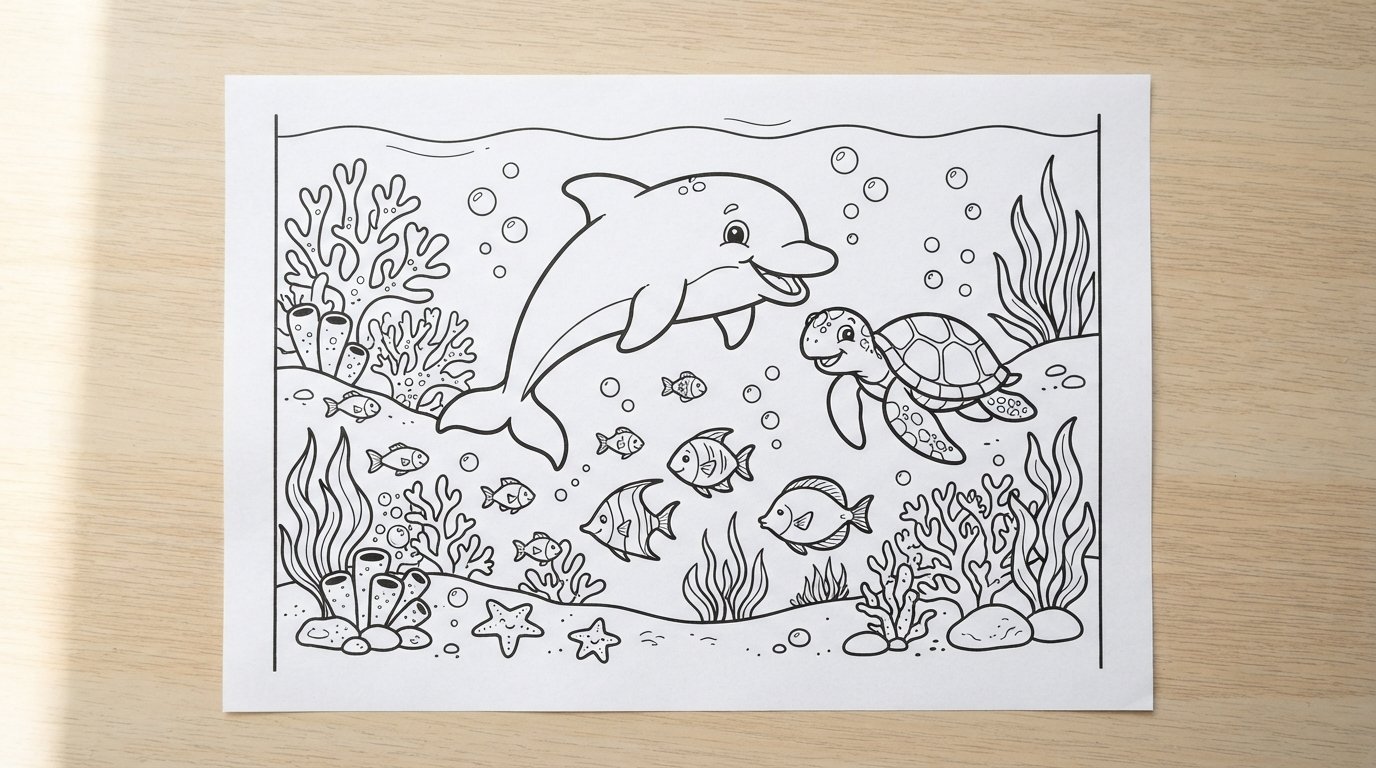

Give a child a picture of the ocean and there is usually something interesting to discover. A smiling fish, a slow-moving sea turtle, a giant whale, or a colorful coral reef can quickly turn a blank sheet of paper into an imaginative underwater scene.
That’s why simple sea life and underwater world coloring worksheets can be such a nice activity for toddlers, preschoolers, and young children. The pictures introduce familiar sea animals while giving children an easy opportunity to practice coloring, choosing colors, counting, and talking about what they see.
The best part is that you don’t need much preparation. A printer, a few sheets of paper, and some crayons are enough to get started.
I prefer simple underwater coloring pages for younger children because they don’t require precise coloring. A large fish with a thick outline is much easier to handle than an extremely detailed coral reef packed with tiny shapes.
This guide covers different sea life coloring ideas, printing tips, simple learning activities, and practical ways to turn underwater coloring pages into something children actually enjoy.
Why Kids Enjoy Underwater Coloring Pages
The ocean is full of animals that look very different from the things children see on land.
A child may already know what a dog or cow looks like, but an octopus with eight arms or a seahorse with its unusual shape can be much more exciting.
A coloring worksheet gives you an easy opportunity to introduce these animals.
For example, when your child is coloring a turtle, you might ask:
“Where is the turtle’s shell?”
“How many flippers can you see?”
“What color would you like to use?”
You don’t need to turn the conversation into a science lesson. A few simple questions can be enough.
What Makes a Good Sea Life Coloring Worksheet?
A good coloring page for younger children should be easy to understand at a glance.
Large, Clear Shapes
Look for animals with large bodies and open areas.
Fish, whales, sharks, turtles, and dolphins can all work well when they have simple outlines.
Thick Lines
Bold outlines make it easier for children to distinguish the animal from the background.
They also make the page easier to color without requiring precise hand control.
Simple Underwater Scenes
A few bubbles, seaweed, rocks, or waves can make a page more interesting without overwhelming a young child.
Familiar and Unusual Animals
It’s useful to include a mixture.
Start with familiar animals such as fish and turtles, then introduce less familiar sea creatures such as octopuses, jellyfish, and seahorses.
Fun Sea Life Coloring Pages to Try
There are many underwater themes you can explore.
Fish Coloring Pages
Fish are one of the easiest places to start.
A simple fish can include:
- Large eyes
- Fins
- Scales
- A tail
- A large body
You can let your child choose the colors.
Instead of telling them what a fish “should” look like, ask:
“What colors do you want your fish to have?”
A child might create a blue-and-yellow fish, a purple fish, or even a rainbow fish.
Sea Turtle Coloring Pages
Sea turtles are excellent coloring subjects because their shells create large sections that children can color individually.
You can ask your child to count the visible flippers or decorate the shell with different colors.
If the page contains several turtles, you can also introduce simple counting.
Dolphin Coloring Pages
Dolphins have a recognizable shape that works nicely in cartoon-style coloring pages.
A simple dolphin page might show the animal jumping above the water or swimming alongside fish.
This can lead to a short conversation about where dolphins live and how they move through water.
Whale Coloring Pages
Whales give children a chance to color a much larger animal.
A cartoon whale can be drawn with a large body and a simple tail.
You can introduce basic size comparisons:
“Is the whale bigger or smaller than the fish?”
This is a very simple way to introduce the idea of big and small.
Octopus Coloring Pages
An octopus can be particularly fun because children can color its arms in different colors.
For a simple activity, ask:
“How many arms can you count?”
You can also use the page to practice counting.
Seahorse Coloring Pages
Seahorses have an unusual shape that can make them interesting for older preschoolers.
Choose a simple outline rather than a page with extremely detailed patterns.
Your child can experiment with different colors and then compare the seahorse with other sea animals.
Jellyfish Coloring Pages
Jellyfish can be drawn with a simple rounded body and long tentacles.
They’re especially suitable for creative coloring because children can use bright colors without needing to follow a realistic pattern.
Shark Coloring Pages
Sharks are another popular choice.
For younger children, friendly cartoon sharks may be more suitable than frightening or realistic illustrations.
You can talk about the shark’s fins, tail, eyes, and teeth while the child colors.
Create a Simple Underwater Scene
Once your child has colored several animals, you can combine them into one larger scene.
Give them a blank sheet of paper and ask them to draw:
- Water
- Seaweed
- Rocks
- Bubbles
- Fish
- A sea turtle
Older preschoolers may enjoy drawing their own underwater world around a printed animal.
This changes the activity from simply coloring inside outlines to creating a scene.
How to Print Sea Life Coloring Worksheets
Printing an underwater coloring worksheet is usually straightforward.
Step 1: Choose a Simple Design
Pick a page appropriate for your child’s age.
For younger children, choose one or two large animals rather than a crowded underwater scene.
Step 2: Open the Printable
If the page is provided as a PDF, open it using your browser or a PDF reader.
You can use a computer, Chromebook, tablet, or smartphone.
Step 3: Check Print Preview
Look at the entire page before printing.
Make sure the animal and its outline fit properly.
If part of the picture is cut off, choose Fit to Page or a similar scaling option.
Step 4: Print in Black and White
Most coloring worksheets only require black outlines.
Black-and-white printing is also convenient if you’re trying to save color printer ink.
Step 5: Start With a Few Pages
Print two or three worksheets first.
You can always print more once you know which animals your child likes.
What Paper Works Best?
Regular printer paper is perfectly suitable for crayons.
If your child uses washable markers, thicker paper can be a better choice because it reduces the chance of ink showing through.
For special artwork you want to save, heavier paper can also make the finished page easier to handle.
There’s no need to buy expensive paper for everyday coloring.
A Simple Coloring Supply Setup
You can create a small underwater coloring kit with:
- Printable sea life pages
- Washable crayons
- Colored pencils
- Washable markers
- Plain paper
- A small tray
- A folder for finished artwork
Keep the supplies together so they’re easy to reach.
A small plastic container can work just as well as a dedicated craft box.
Let Children Choose Their Own Colors
One of the easiest ways to make coloring more enjoyable is to avoid correcting every color choice.
A child might color a whale orange or make a green dolphin.
That’s fine.
Coloring is not a test of scientific accuracy.
You can even encourage imagination by asking:
“What would your underwater world look like?”
This gives the child permission to experiment.
Add a Simple Counting Game
Underwater pages are excellent for counting activities.
If the worksheet contains several fish, ask:
“How many fish do you see?”
If there are bubbles, ask the child to count those instead.
Keep the numbers small for younger children.
For older preschoolers, you can gradually use pages with more objects.
Practice Sea Animal Names
Some children will already know common words such as fish and whale.
Others may not know words such as:
- Octopus
- Seahorse
- Jellyfish
- Stingray
- Clam
- Starfish
Introduce one or two new words at a time.
There’s no need to memorize a long list.
Simply repeat the animal’s name naturally while coloring.
Use a Sea Life Picture Book
If you have an ocean-themed children’s book, keep it nearby.
After your child colors an animal, try finding a picture of the same animal in the book.
For example:
“Here’s your turtle. Can you find a turtle in the book?”
This connects the coloring activity with books and visual recognition.
Try a “Big and Small” Game
Underwater animals come in many different sizes, making them useful for simple comparisons.
Place pictures of a small fish and a large whale beside each other.
Ask:
“Which one is bigger?”
“Which one is smaller?”
You can repeat the activity with a seahorse and dolphin or a crab and whale.
Make an Ocean-Themed Coloring Book
If your child really enjoys sea animals, you can create a homemade coloring book.
Choose around 10 pages.
For example:
- Fish
- Sea turtle
- Dolphin
- Whale
- Octopus
- Seahorse
- Jellyfish
- Shark
- Starfish
- Underwater scene
Place them in a folder or bind them with simple binder rings.
Let your child decorate the cover.
You could write:
My Underwater Coloring Book
Then add your child’s name underneath.
Don’t Make Every Page a Worksheet
A small mistake parents sometimes make is turning every coloring activity into a lesson.
“What animal is this?”
“How many fins?”
“What color is it?”
“What does it eat?”
After several questions, the child may stop enjoying the activity.
It’s okay to simply let them color.
Some days can be about learning.
Other days can simply be about having fun.
Use Toy Sea Animals
If you have plastic sea animal toys, bring them to the table.
Place a toy turtle next to a turtle coloring page.
Ask your child to compare them.
“Can you find the shell?”
“Where are the flippers?”
You can do the same with toy sharks, whales, dolphins, or fish.
This creates a simple connection between the physical toy and the printed picture.
Make a DIY Ocean Scene
After coloring several animals, give your child a large sheet of paper.
Help them create an underwater background.
They could draw:
- Blue water
- Green seaweed
- Brown rocks
- Bubbles
- Coral
- Fish
- Shells
If they want to add a submarine or treasure chest, let them.
It doesn’t have to be scientifically accurate.
The goal is creative play.
Sea Life Coloring for Different Ages
Children develop at different rates, but the complexity of the worksheet can be adjusted.
Younger Toddlers
Use:
- One large fish
- One turtle
- Thick outlines
- Large open spaces
- Minimal background
Expect scribbling and coloring outside the lines.
Preschoolers
Try:
- Multiple fish
- Dolphins
- Whales
- Octopuses
- Simple underwater scenes
- Counting activities
Older Preschoolers
Introduce:
- Detailed underwater scenes
- Several sea animals
- Ocean habitats
- Simple drawing activities
- Matching games
- Basic sea life vocabulary
A Mistake to Avoid With Detailed Pages
A beautiful underwater illustration can sometimes be too complicated for a young child.
A page filled with dozens of tiny fish, coral branches, bubbles, shells, and seaweed may look impressive to an adult but frustrating to a preschooler.
Start simple.
You can always increase the detail as your child becomes more comfortable with coloring.
Screen-Free Ocean Activity
One useful feature of printable worksheets is that they can provide an activity without requiring a screen during the actual coloring.
You might use a laptop or phone to find the page and print it.
After that, put the device away.
Place the paper and crayons on the table.
Your child can then work with physical materials.
This can be especially useful when you want a quiet activity during an afternoon at home.
Take Underwater Coloring on a Trip
A few printed sea life pages can easily fit into a folder or backpack.
Pack:
- Five coloring pages
- A small crayon box
- A clipboard
- A few blank sheets
A clipboard can be useful when there isn’t a proper table.
For travel, crayons are generally less messy than markers.
Safety Tips for Young Children
Use age-appropriate art supplies and check the manufacturer’s recommendations before giving them to a child.
Washable crayons and markers are practical choices for young children because accidental marks are generally easier to clean.
Children who still put objects in their mouths should be supervised closely around art materials.
Avoid small craft pieces that could present a choking risk.
Keep the coloring area comfortable and free from unnecessary clutter.
Frequently Asked Questions
What sea animals are easiest for kids to color?
Fish, turtles, whales, dolphins, sharks, and octopuses are good choices because they can be represented using large, recognizable shapes.
Can toddlers use underwater coloring pages?
Yes. Choose very simple pages with one large animal, thick outlines, and plenty of open space.
What paper should I use for coloring worksheets?
Regular printer paper works well for crayons. Heavier paper is useful for markers or artwork you want to preserve.
Can I print coloring worksheets from a phone?
Yes. If your printer supports wireless printing, you can generally print a PDF or image directly from your phone using compatible printing features or the printer manufacturer’s app.
How can I make sea life coloring educational?
You can introduce animal names, count fish or bubbles, compare animal sizes, identify body parts, and discuss simple ocean habitats.
Should children use realistic colors?
Not necessarily. Let children choose their own colors. Creative freedom is one of the main benefits of coloring.
A Simple Underwater Coloring Activity
For a relaxed afternoon, print three pages:
Page 1: Fish
Page 2: Sea turtle
Page 3: Octopus
Put a small selection of crayons on the table.
Let your child choose which page to start with.
While they color, talk about the animal if they want to.
Afterward, give them a blank sheet of paper.
Ask:
“Can you draw an ocean for your animals?”
They might draw waves, rocks, seaweed, a submarine, or something completely unexpected.
Let them decide.
Final Thoughts
Simple sea life coloring worksheets can turn an ordinary piece of printer paper into a small underwater adventure.
Start with familiar animals such as fish and turtles, then gradually introduce more unusual creatures such as octopuses, jellyfish, seahorses, and stingrays.
Keep the first pages simple, use thick outlines, and don’t worry about whether every color is realistic.
A preschooler’s ocean doesn’t have to follow the rules.
It can have a purple whale, orange seaweed, blue starfish, and a rainbow fish swimming past a giant green turtle.
That’s part of what makes coloring enjoyable.
Print a few pages, put the crayons on the table, and give your child enough freedom to create an underwater world of their own.