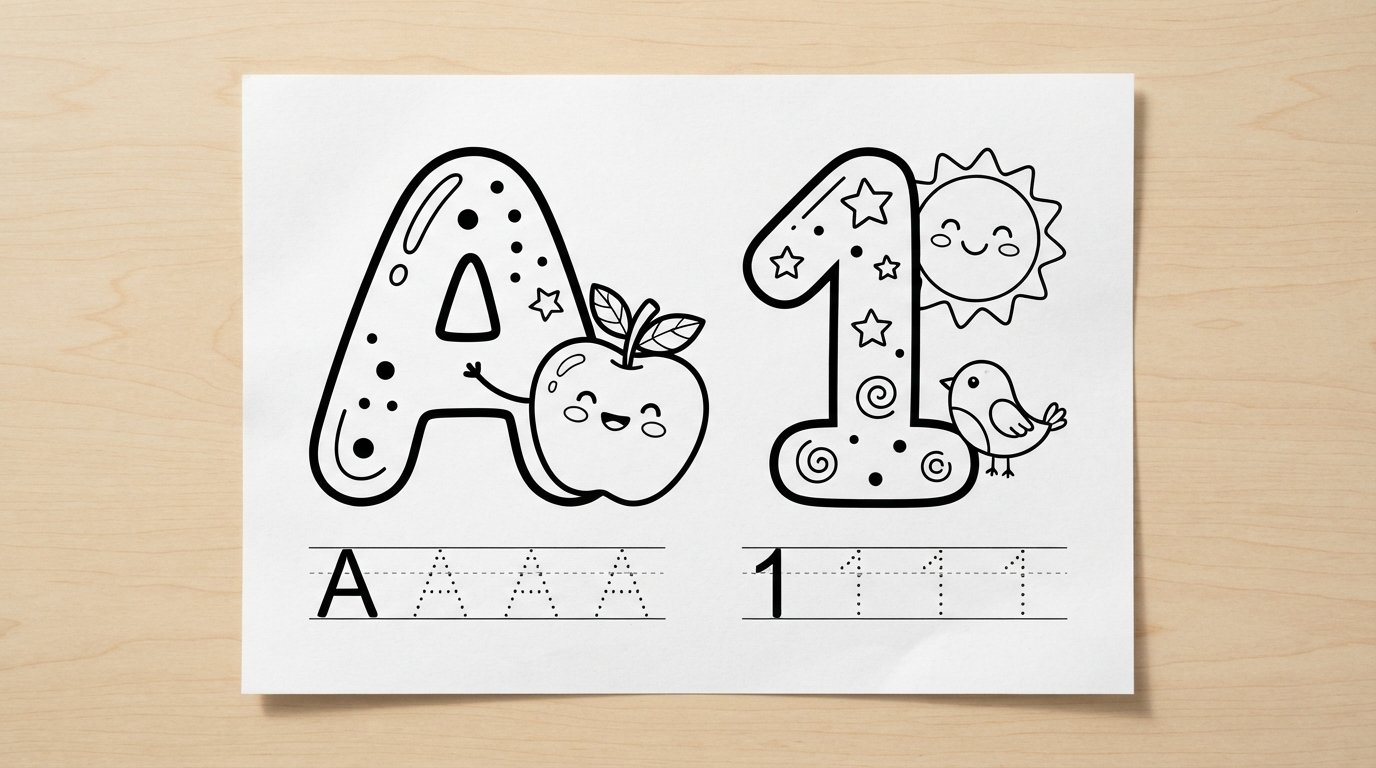

Learning letters and numbers doesn’t always have to involve worksheets, flashcards, or sitting quietly at a desk. For young children, a few crayons and a simple coloring page can make early learning feel much more natural.
Alphabet and number coloring pages for early learning are useful because they combine basic educational concepts with an activity children already enjoy. Instead of asking a preschooler to repeatedly write the letter “A,” you can give them a large letter A to color, along with a picture of an apple.
The same idea works with numbers.
A page showing the number 3 alongside three apples gives a child an opportunity to see the number, color the picture, and begin connecting the symbol with quantity.
You don’t need an elaborate home classroom to use these activities. A kitchen table, some paper, and washable crayons can be enough.
This guide explains how to use alphabet and number coloring pages effectively, how to choose age-appropriate designs, and how to turn simple coloring sheets into relaxed early-learning activities.
Why Coloring Can Support Early Learning
Young children learn through repetition, movement, conversation, and hands-on activities.
Coloring adds a physical element to learning. Instead of only looking at a letter on a screen or in a book, the child is touching the paper, moving a crayon across the shape, and looking closely at the symbol.
For example, a child might color a large letter B while you say:
“B is for ball.”
Then they can color the picture of a ball beside it.
You don’t need to repeat the phrase dozens of times. A few natural repetitions during different activities can help the child become familiar with the letter.
What Makes a Good Alphabet Coloring Page?
Alphabet pages for young children should be easy to understand.
Large Letters
Large uppercase letters are usually easier for beginners to recognize and color.
A giant A gives a child plenty of space to move a crayon.
Simple Pictures
Pairing letters with familiar objects can make the page more interesting.
Examples include:
- A for Apple
- B for Ball
- C for Cat
- D for Dog
- E for Elephant
- F for Fish
- G for Goat
- H for Hat
The pictures don’t need to be complicated.
Thick Outlines
Bold lines help children see the shape of the letter and the object.
They also make the page more suitable for children who are still developing fine motor control.
Start With Familiar Letters
You don’t necessarily have to teach the alphabet from A to Z in order.
A child may already recognize the first letter of their name.
If their name begins with M, for example, you could start with M.
You might say:
“That’s your M.”
Then let them color the letter.
Personal connections can make letters more interesting.
Alphabet Coloring Ideas
You can create different types of alphabet pages depending on what your child enjoys.
One Letter Per Page
This is probably the simplest format.
A page might contain:
A
Apple
The child colors both.
This format is particularly useful for younger preschoolers.
Uppercase and Lowercase Letters
For children who are becoming familiar with letter shapes, a page can show:
A a
along with an object beginning with A.
This introduces the idea that uppercase and lowercase letters can look different while representing the same letter.
Alphabet Animal Pages
Animals can make alphabet practice more fun.
For example:
C — Cat
D — Dog
E — Elephant
L — Lion
M — Monkey
You can connect this with the animal coloring pages your child may already enjoy.
Don’t Expect Perfect Letter Recognition
One mistake adults sometimes make is expecting children to remember every letter after seeing it once.
Early learning takes repetition.
A child might recognize A one day and forget it the next.
That’s normal.
Instead of saying:
“You already learned this!”
simply repeat the letter naturally.
“That’s A. A is for apple.”
Then continue coloring.
Keeping the experience relaxed is usually more useful than turning every page into a test.
Number Coloring Pages for Early Learning
Numbers can be introduced in a similar way.
A large number becomes easier to understand when it is paired with objects.
For example:
5
🍎 🍎 🍎 🍎 🍎
The child can color the number and the five apples.
This provides two things to look at:
- The written number
- The amount it represents
Start With Small Numbers
For beginners, numbers from 1 to 5 are a good starting point.
You can gradually introduce:
1–5
then:
6–10
and later larger numbers when your child is ready.
There’s no need to rush through the entire number system.
Use Objects Children Know
Numbers become easier to discuss when the objects are familiar.
Try pictures of:
- Apples
- Balloons
- Stars
- Cars
- Fish
- Flowers
- Animals
- Blocks
- Toy trains
For example, a page showing the number 4 with four cars can combine number recognition with a topic the child already likes.
Count While Coloring
You can turn a simple page into a counting activity.
Suppose the page has five fish.
Point to each one:
“One.”
“Two.”
“Three.”
“Four.”
“Five.”
Then ask:
“How many fish?”
If the child answers incorrectly, simply count them again together.
There’s no need to make the child feel that they got something wrong.
Number Coloring Pages for Different Ages
Again, every child develops differently, but you can adjust the complexity.
Younger Learners
Use:
- Numbers 1–5
- Large numerals
- Large pictures
- Simple objects
- Thick outlines
Older Preschoolers
Try:
- Numbers 1–10
- Counting groups
- Number matching
- Simple addition pictures
- Number sequences
For example:
1, 2, 3, __, 5
The child can color the numbers first and then talk about which number is missing.
Combine Letters and Numbers
You don’t have to keep alphabet and number activities completely separate.
A page can combine both.
For example, you might have:
A
1 Apple
The child colors the letter, the number, and the apple.
This creates a small multi-skill activity without requiring a complicated worksheet.
How to Print Alphabet and Number Coloring Pages
Printable pages are easy to prepare if you already have access to a home printer.
Step 1: Choose the Right Page
Look for large letters or numbers and simple illustrations.
Avoid pages with tiny details if the activity is intended for a toddler or younger preschooler.
Step 2: Open the Printable File
PDF files can usually be opened on a Windows computer, Mac, Chromebook, tablet, or smartphone.
Step 3: Check Print Preview
Make sure the entire page is visible.
If part of the letter or number is being cut off, select Fit to Page or adjust the scaling.
Step 4: Choose Black-and-White
Most educational coloring pages only require black outlines.
This also helps conserve color printer ink.
Step 5: Print a Small Selection
You don’t need to print the entire alphabet and numbers 1–100 at once.
Start with a few pages.
See which ones your child enjoys before printing more.
What Paper Should You Use?
Regular printer paper is usually enough for crayons.
If your child uses washable markers, thicker paper can be useful.
For pages you want to keep, cardstock or heavier paper can make the finished artwork easier to store.
There’s no need to buy expensive art supplies for basic early-learning activities.
Use Washable Crayons and Markers
Young children can be creative with art supplies, and that creativity occasionally ends up on the table.
Washable crayons and markers can make cleanup easier.
Keep the supplies appropriate for your child’s age and follow the manufacturer’s recommendations.
A small container with six to eight crayons is often enough.
You don’t need to put the entire art box on the table.
A Simple Alphabet Coloring Routine
You can create a very simple routine at home.
Choose one letter.
For example:
B
Print a page with a large B and a ball.
Ask:
“What letter is this?”
Then say:
“B is for ball.”
Let your child color.
Later in the day, look for the letter B in a children’s book or on a familiar sign.
The goal isn’t to complete a certain number of letters each day.
It’s to give your child repeated, relaxed exposure.
Make a Name Letter Activity
Children often become interested when learning connects to their own name.
Write the child’s first name in large letters on a sheet of paper.
You can then ask them to color the first letter.
For example:
M A R Y
“Can you find M?”
This doesn’t need to become a handwriting exercise.
Simply recognizing a familiar letter can be a useful first step.
Turn Number Coloring Into a Snack Game
You can use everyday objects to reinforce number concepts.
Suppose you’re coloring the number 3.
After finishing the page, place three pieces of fruit on the table.
Count them together.
“One, two, three.”
This connects the printed number with a real quantity.
You can do the same thing with blocks, toy cars, or other age-appropriate objects.
Make a Counting-and-Coloring Game
Here’s a simple activity:
Print a page with six balloons.
Ask your child to color three balloons red and three balloons blue.
The exact colors don’t matter.
You’re simply encouraging them to count and follow a simple instruction.
If the child loses interest, stop there.
The activity doesn’t need to be completed perfectly.
Don’t Correct Every Coloring Choice
If your child colors the letter A purple, that’s fine.
If they color every number blue, that’s also fine.
The color isn’t the learning objective.
The important part is that they are interacting with the letter or number.
Avoid turning coloring into a test where every choice has to match an adult’s example.
Use Favorite Themes
One practical trick is to connect learning pages with your child’s existing interests.
If your child loves animals, use:
A for Alligator
B for Bear
C for Cat
If they love vehicles:
B for Bus
C for Car
T for Truck
If they love the ocean:
D for Dolphin
F for Fish
S for Shark
The familiar subject can make the educational page more appealing.
Create an Alphabet Folder
If you’re using printable pages regularly, create a folder on your computer.
For example:
Early Learning
→ Alphabet
→ Numbers
→ Colors
→ Shapes
You can also create a physical folder for finished pages.
Your child can look through the folder later and see their progress.
Make a Homemade Alphabet Book
Print one letter per page.
Then place the pages in alphabetical order.
You could include:
A — Apple
B — Ball
C — Cat
and continue through the alphabet.
Let your child color each page.
The result is a simple homemade alphabet book that can be used again and again.
Make a Number Book Too
The same idea works with numbers.
Start with 1 and create pages through 10.
For example:
1 — One apple
2 — Two apples
3 — Three apples
Continue until 10.
The child can color the number and the matching objects.
You can then use the finished book for simple counting practice.
A Mistake to Avoid: Doing Too Much at Once
It can be tempting to teach letters, numbers, colors, shapes, animals, and writing skills in one sitting.
That can quickly become tiring for a young child.
A better approach is to keep the activity focused.
Today might be:
Letter C
Tomorrow:
Number 3
Another day:
Letter D
Short, enjoyable activities are perfectly fine.
Let Children Color at Their Own Pace
Some children carefully color inside every shape.
Others cover the page in a few seconds.
Both approaches are normal.
Don’t compare your child’s coloring with another child’s work.
Early learning isn’t a race.
If your child wants to stop after coloring half of the letter, you can save the page and come back to it later.
Display the Finished Pages
A simple way to make children feel proud of their work is to display it.
You could place finished pages:
- On the refrigerator
- On a bedroom wall
- On an activity board
- In a folder
- In a scrapbook
You can also rotate the artwork every few days.
There’s no need to display everything permanently.
Frequently Asked Questions
Are alphabet coloring pages good for preschoolers?
They can be a useful early-learning activity when combined with age-appropriate conversations, repetition, and other forms of play.
What age should children start learning letters?
Children develop at different rates. Some become interested in letters early, while others take longer. Simple coloring activities can provide exposure without requiring formal instruction.
What numbers should preschoolers learn first?
Starting with numbers 1 through 5 is a simple approach, followed by 6 through 10 as the child becomes comfortable with counting.
Can I print alphabet coloring pages from my phone?
Yes. If your printer supports wireless printing, you can usually print PDFs or images from a smartphone using compatible printing features or the printer manufacturer’s app.
Should alphabet coloring pages include pictures?
Pictures can be helpful because they connect the letter with a familiar word, such as A for Apple or B for Ball.
Do children need to color inside the lines?
No. Young children are still developing fine motor control. Coloring outside the lines is normal.
A Simple 15-Minute Early Learning Activity
You don’t need a long lesson.
Try this:
First 5 minutes: Choose one alphabet coloring page.
Next 5 minutes: Talk about the letter and picture while your child colors.
Last 5 minutes: Find the same letter in a book or write it on a blank piece of paper.
On another day, repeat the process with a number.
For example:
Number 4
Count four objects.
Color the number.
Then look for the number 4 somewhere around the house.
That’s enough.
Final Thoughts
Alphabet and number coloring pages can make early learning feel less like a lesson and more like ordinary play.
The key is keeping things simple.
Choose large letters, clear numbers, familiar pictures, and designs that match your child’s age. Give them a few crayons and enough freedom to explore.
Don’t worry if the letter A ends up covered in purple scribbles or if your child counts the same three apples five times.
Those small moments are part of learning.
Over time, you can introduce more letters, larger numbers, matching activities, simple counting games, and homemade coloring books.
You don’t need a perfect classroom setup.
A printed page on the kitchen table can be enough to start a useful little learning moment.