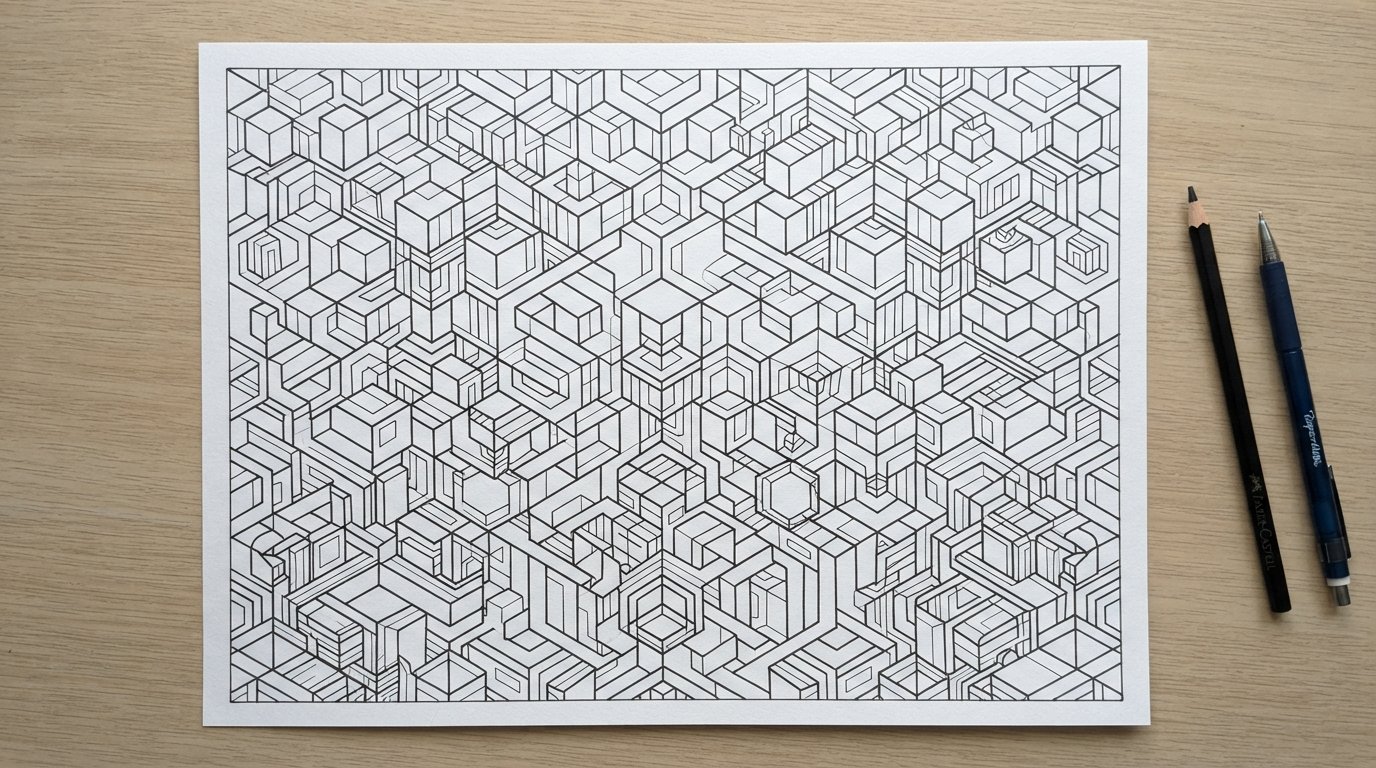

Geometric and abstract coloring pages offer a different experience from traditional flower, animal, or landscape designs. Instead of coloring recognizable objects, you work with shapes, lines, curves, grids, circles, and repeating patterns.
That makes these pages especially interesting for adults who enjoy structure and experimentation.
A detailed geometric coloring page might contain dozens of repeating shapes. An abstract design may have curved lines that form unexpected sections across the entire page. You can follow a planned color scheme, repeat a simple pattern, or ignore traditional rules and see what develops.
You don’t need drawing experience to enjoy them. The design is already on the page. Your job is simply to decide how to bring it to life.
What Are Geometric Coloring Pages?
Geometric coloring pages are illustrations built around mathematical or structured shapes.
Common elements include:
- Circles
- Squares
- Triangles
- Hexagons
- Diamonds
- Spirals
- Grids
- Arches
- Lines
- Symmetrical patterns
- Repeating shapes
- Overlapping forms
Some designs are simple, with large spaces that are easy to fill. Others are extremely detailed and may take several coloring sessions.
The repeating structure makes these pages different from ordinary illustrations.
Abstract Coloring Pages Take a More Flexible Approach
Abstract patterns don’t necessarily represent a specific object.
Instead, they may combine lines, shapes, textures, and unusual forms.
You might find:
- Curved patterns
- Random-looking shapes
- Optical-style designs
- Interlocking sections
- Waves
- Dots
- Spirals
- Layered circles
- Decorative lines
There is no correct way to color an abstract page.
That freedom can be one of its biggest attractions.
Why Detailed Patterns Can Be Engaging
A highly detailed page gives you many small decisions to make.
Which color should go here?
Should the next shape match the previous one?
Should the pattern repeat?
Should you create contrast?
Those decisions keep your attention connected to the page.
For example, you might spend several minutes coloring a ring of triangles around a central circle. Once that section is complete, you move outward to the next layer.
The page provides a clear structure while you control the visual result.
Start From the Center
One simple approach is to begin in the middle of a geometric design.
Choose two or three colors and work outward.
For example:
Center: Yellow
First ring: Orange
Second ring: Red
Outer ring: Purple
This creates a gradual transition from the center toward the edges.
You don’t have to follow this method every time, but it can help when you’re unsure where to begin.
Try the Outside-In Method
The opposite approach can also be interesting.
Start with the outer border.
Choose a strong color for the edge and gradually work toward the center.
This works particularly well with designs containing multiple circular layers.
The advantage is that the outside edge becomes visually defined before you tackle the smaller interior sections.
Use Repeating Color Patterns
Geometric pages are perfect for repeated color sequences.
Choose three colors.
For example:
Blue → Yellow → Purple
Color the first shape blue, the next yellow, the next purple, and then repeat the sequence.
You can use the same method across rows, rings, triangles, or other repeating sections.
The result can look carefully planned even though the coloring process is very simple.
Create a Symmetrical Design
If your page has symmetrical shapes, use the same colors on opposite sides.
For example, if the design has four identical sections, color each section using the same palette.
This can produce a balanced appearance.
You can also break the symmetry intentionally.
Color the left side with cool colors and the right side with warm colors.
The choice is yours.
Warm vs. Cool Color Schemes
One easy way to plan an abstract coloring page is to decide whether you want warm or cool colors.
Warm Colors
Try:
- Red
- Orange
- Yellow
- Coral
- Warm pink
These colors can create an energetic appearance.
Cool Colors
Try:
- Blue
- Green
- Purple
- Teal
- Blue-gray
These colors can create a quieter visual effect.
Mixed Palette
You can combine both groups.
For example, use cool blue and green for most of the design, then add small orange sections as accents.
Try a Black-and-White Pattern
You don’t have to fill every section with bright colors.
A black, gray, and white palette can create a completely different look.
Use dark gray for large shapes, lighter gray for smaller sections, and leave selected areas white.
This can work especially well for highly detailed geometric designs.
Metallic Colors Can Add Interest
If you have metallic colored pencils or gel pens, use them for small accents.
Gold, silver, and bronze can work well in:
- Borders
- Small circles
- Decorative lines
- Central shapes
- Repeating accents
You don’t need to use metallic colors everywhere.
A few small highlights can be enough.
Colored Pencils Give You More Control
Detailed geometric coloring often involves small sections, so precision matters.
Colored pencils are useful because you can sharpen them to a fine point.
Start with light pressure.
If the section needs more color, gradually build it up.
This is particularly helpful when two adjacent shapes need different shades but you want a smooth, controlled appearance.
Fine-Tip Markers Work for Bold Designs
Fine-tip markers can make geometric patterns look bright and clean.
They’re particularly useful for pages with:
- Large geometric sections
- Strong outlines
- Repeating shapes
- Bold abstract patterns
Before using markers, test them on a spare piece of the same paper.
Some markers bleed through thin printer paper.
Place another sheet underneath the page if necessary.
Don’t Use Too Many Colors at Once
A large geometric design can contain hundreds of individual sections.
Using a different color for every section can quickly make the page look chaotic.
Instead, start with four to six colors.
You can always introduce another color later.
A limited palette also makes it easier to maintain visual consistency.
Use One Color Family
Another simple technique is to stay within one color family.
For example, use different shades of blue:
- Pale blue
- Sky blue
- Medium blue
- Dark blue
- Navy
The design remains colorful while still feeling organized.
You can do the same with green, purple, orange, or another color.
Create Contrast With Light and Dark
Contrast can make geometric patterns easier to see.
If one section is dark blue, place a lighter color next to it.
For example:
Dark purple + light yellow
or
Deep green + pale pink
You don’t need advanced color theory.
Simply placing noticeably lighter and darker shades next to one another can make shapes stand out.
Try a Gradient Across the Page
You can gradually change colors as you move across the design.
Start with yellow on the left.
Move toward orange in the center.
Finish with red on the right.
For a cool palette:
Light blue → medium blue → purple
This can work particularly well with abstract wave or circular patterns.
Use White Space Intentionally
Leaving an area uncolored isn’t necessarily unfinished.
White space can provide contrast between busy sections.
For example, color every other shape in a repeating geometric pattern and leave the remaining shapes white.
The result can look much more deliberate than filling everything with color.
Break a Large Design Into Sessions
Some detailed abstract coloring pages are simply too large to finish in one sitting.
That’s completely fine.
Divide the page into sections.
You could color:
Session 1: Center
Session 2: Upper section
Session 3: Lower section
Session 4: Outer border
Use the same color palette throughout if you want the final image to look consistent.
Use a Simple Color Key
If you’re working on a complicated pattern over several days, create a small color key.
Write something like:
A = Blue
B = Purple
C = Yellow
D = Green
You don’t need to label every section.
The key simply helps you remember your chosen palette when you return to the page later.
Make a Color Test Sheet
Before starting a complicated design, print a small copy or use a blank piece of paper.
Test your colors next to each other.
For example:
- Blue + orange
- Purple + yellow
- Green + pink
Some combinations may look different on paper than they did in your head.
A quick test can save you from changing the entire page later.
How to Print Detailed Geometric Coloring Pages
A home printer can handle most black-and-white coloring designs.
Step 1: Open the Printable
Use a PDF or high-resolution image when possible.
Step 2: Check the Print Preview
Make sure the entire design fits on the page.
Detailed patterns can lose important sections if the printer crops the edges.
Step 3: Select Paper
Regular printer paper works well with colored pencils.
Thicker paper is more suitable for markers or heavier coloring tools.
Step 4: Print a Test
Check whether the smallest lines are visible.
If the design is extremely detailed, make sure the print size isn’t too small.
Step 5: Start Coloring
Place the printed sheet on a flat surface and begin with whichever section looks most appealing.
Don’t Forget the Paper Size
If a design contains very small shapes, printing it too small can make coloring uncomfortable.
If your printer supports different paper sizes, consider using a larger sheet.
You can also use the printer’s scaling options to make the design slightly larger, as long as the outer edges remain visible.
Make Coloring More Comfortable
Detailed patterns can require you to look closely for extended periods.
A few simple habits can help:
- Use comfortable lighting.
- Keep your paper on a flat surface.
- Take occasional breaks.
- Keep your pencils sharpened.
- Avoid pressing extremely hard.
- Change your hand position when necessary.
If your hand or eyes become tired, stop for a while.
There is no benefit to forcing yourself through a page.
Try Abstract Coloring Without a Plan
Not every coloring session needs a color strategy.
Print an abstract design and choose colors randomly.
Pick one color without thinking too much.
Then choose another.
Continue until the page begins to develop its own pattern.
This can be a fun change when you normally plan everything.
Turn Coloring Into a Design Experiment
You can learn a little about color combinations simply by repeating the same design.
Print the same abstract pattern three times.
Use:
Version 1: Warm colors
Version 2: Cool colors
Version 3: Black, white, and one accent color
Put the three versions next to one another.
You’ll see how dramatically the mood of the same design can change.
Make a Personal Pattern Collection
If you enjoy detailed coloring, keep your completed pages.
Use a folder or binder with sections for:
- Geometric patterns
- Abstract designs
- Symmetrical patterns
- Color experiments
- Favorite pages
Write the date and palette on the back.
This gives you an easy way to remember which combinations you liked.
Coloring Can Be a Screen-Free Hobby
One of the simplest reasons to keep printable coloring pages around is that they don’t require another digital device.
You can print a page and leave your phone somewhere else.
Spend a short period working with pencils and paper.
You don’t have to listen to anything or check notifications.
If you enjoy background audio, quiet music or an audiobook can also work.
The important thing is that the activity remains enjoyable rather than becoming another obligation.
Coloring With Other People
Geometric patterns can work well for group coloring.
Give everyone the same design.
Then ask each person to choose a different color palette.
One person might use neon colors.
Another might choose earthy tones.
Someone else might use only three colors.
Comparing the finished pages can be more interesting than trying to decide which one is “best.”
Frequently Asked Questions
What are geometric coloring pages?
They are coloring illustrations built around structured shapes such as circles, triangles, squares, grids, diamonds, lines, and repeating patterns.
What are abstract coloring pages?
Abstract coloring pages use non-representational shapes, lines, textures, and patterns instead of depicting a specific object or scene.
Are detailed geometric coloring pages suitable for beginners?
Yes, although beginners may find simpler designs more comfortable. Start with larger sections before moving to very intricate patterns.
Which coloring tools are best?
Colored pencils are a versatile choice for detailed work. Fine-tip markers are useful when you prefer bright, bold colors.
How many colors should I use?
There is no fixed number. Four to six colors are a good starting point if you want an organized design.
Can I use markers on printer paper?
You can, but some markers may bleed through thin paper. Test them first and place another sheet underneath the coloring page.
Do geometric coloring pages need to be symmetrical?
No. Symmetry is common in geometric designs, but abstract and geometric coloring pages can be completely irregular.
A Simple 20-Minute Geometric Coloring Activity
Try this if you want a short creative break.
Minutes 1–3: Choose a page and four colors.
Minutes 4–8: Color the center.
Minutes 9–14: Repeat the color pattern around the next section.
Minutes 15–18: Add contrast with a darker or lighter shade.
Minutes 19–20: Choose one small area for a final accent.
Then put the page away.
You can continue it later or start another design next time.
Final Thoughts
Detailed geometric and abstract pattern coloring pages give adults a structured creative activity without requiring them to draw anything from scratch.
Circles, triangles, grids, spirals, waves, and repeating patterns provide the framework. Your color choices determine the final appearance.
You can carefully plan every shade, follow a repeating pattern, experiment with unexpected combinations, or simply choose colors as you go.
Start with a design that matches your comfort level and a small collection of colored pencils. If the page is complicated, work on it over several sessions rather than trying to finish it immediately.
There is no single correct way to color an abstract pattern. That’s what makes these pages so flexible.