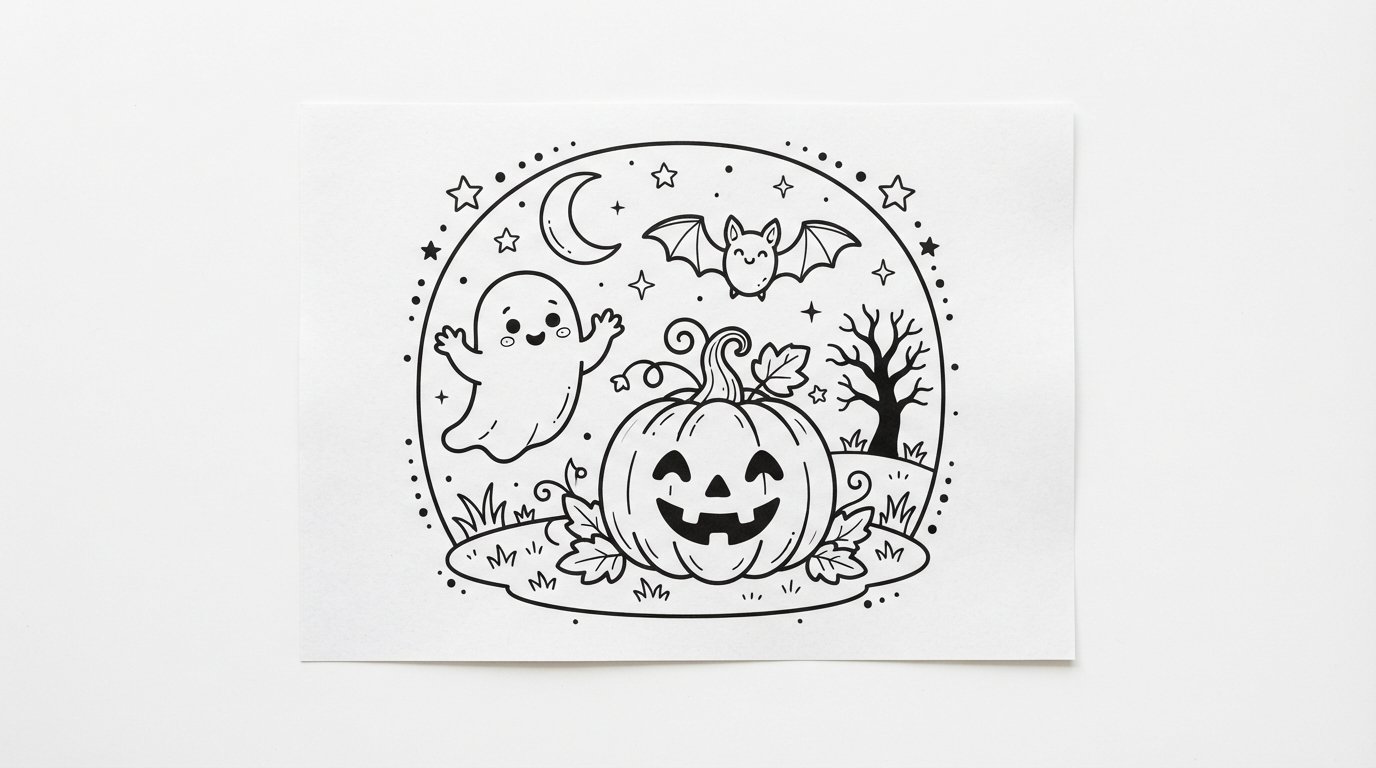

Halloween coloring pages are an easy way to bring seasonal creativity to kids’ activities without needing a complicated craft setup. A few printed pages, some crayons or colored pencils, and a table are enough to turn an ordinary afternoon into a Halloween-themed coloring session.
Pumpkins, friendly ghosts, bats, witches’ hats, candy, haunted houses, and spider webs all work well as coloring subjects. You can keep the designs cute and simple for younger children or choose more detailed illustrations for older kids, teens, and adults.
The best part about Halloween coloring is that there isn’t one correct color scheme. A pumpkin can be traditional orange, a ghost can be white, and a haunted house can be dark purple—or children can use completely imaginative colors.
Why Halloween Coloring Pages Are So Popular
Halloween naturally provides plenty of fun visual elements.
A single coloring sheet can include:
- Pumpkins
- Jack-o’-lanterns
- Friendly ghosts
- Bats
- Black cats
- Spiders
- Spider webs
- Candy
- Witch hats
- Haunted houses
- Autumn leaves
- Full moons
- Graveyard decorations
- Halloween signs
These recognizable objects make it easy for children to understand what they are coloring.
At the same time, the designs can be adjusted for different ages.
A preschooler might enjoy a large pumpkin with a simple face, while an older child may prefer a detailed haunted-house scene.
Start With Simple Pumpkin Coloring Pages
Pumpkins are one of the easiest Halloween subjects to color.
For younger children, look for pages with:
- Large pumpkin sections
- Thick outlines
- Simple faces
- Minimal background details
A child can color the pumpkin orange and the stem green or brown.
They can also experiment with purple, blue, pink, or any other color they like.
The goal is to make the activity enjoyable rather than insist that every pumpkin look realistic.
Get Creative With Jack-o’-Lantern Faces
Jack-o’-lanterns give children another layer of creativity because they can color both the pumpkin and its face.
You might find:
- Smiling faces
- Surprised faces
- Funny faces
- Sleepy faces
- Scary-looking expressions
- Silly expressions
Ask children what kind of personality their pumpkin has.
They can choose colors for the eyes, nose, and mouth after finishing the main pumpkin.
This turns a basic coloring page into a small storytelling activity.
Friendly Ghost Coloring Pages
Ghosts are another classic Halloween subject.
For younger children, friendly ghost illustrations with large open areas are easier to color.
A traditional approach would be:
Ghost: White or light gray
Eyes: Black
Mouth: Black or dark gray
But there is no rule that a ghost has to be white.
Try:
- Light blue
- Purple
- Pink
- Pale green
- Gray
You can even create a whole page of ghosts in different colors.
Keep Spooky Designs Kid-Friendly
“Spooky” doesn’t have to mean frightening.
For younger children, choose Halloween pages featuring smiling pumpkins, cute ghosts, cartoon bats, and friendly animals.
Avoid pages with imagery that may be too frightening for the child you’re working with.
Older children may enjoy more detailed haunted houses or mysterious nighttime scenes.
The right level of spookiness depends on the child’s age and comfort level.
Add Color to the Halloween Background
A Halloween coloring page often has more than one main character.
The background can include:
- Moonlight
- Clouds
- Trees
- Grass
- Houses
- Stars
- Bats
- Leaves
You don’t need to color everything immediately.
Start with the main subject and then work outward.
For example:
Pumpkin: Orange
Stem: Green
Grass: Green
Sky: Dark blue
Moon: Yellow
Bats: Black
This gives the page a recognizable nighttime Halloween appearance.
Try a Traditional Halloween Palette
If you want a classic look, use familiar Halloween colors.
A simple palette could include:
- Orange
- Black
- Purple
- Green
- Yellow
Orange works naturally for pumpkins.
Black can be used for bats, cats, and outlines.
Purple can add color to clothing, backgrounds, or decorations.
Green works for stems, leaves, and certain monster-themed details.
Yellow is useful for moonlight, stars, and jack-o’-lantern glow.
Experiment With Unexpected Colors
Children don’t need to follow traditional Halloween colors.
Try:
Pink pumpkins
Blue ghosts
Purple cats
Green moons
Rainbow candy
The unusual combinations can make coloring more playful.
You can ask a simple question:
“What color would you choose if this pumpkin could be any color?”
There isn’t a wrong answer.
Use Colored Pencils for Detailed Halloween Pages
Colored pencils are useful when the design contains small sections.
They’re particularly helpful for:
- Pumpkin faces
- Small candy pieces
- Spider webs
- Costume details
- Tiny stars
- Haunted-house decorations
A sharpened pencil gives better control around narrow areas.
For younger children, chunky crayons may be easier to grip.
Crayons Are Great for Younger Children
Large crayons are simple to use and generally well suited to basic coloring activities.
For preschoolers, choose pages with large sections and thick outlines.
You can also place a sheet of newspaper or scrap paper under the coloring page if you want to protect the table.
Keep coloring materials appropriate for the child’s age and follow the manufacturer’s guidance.
Fine-Tip Markers for Older Kids
Fine-tip markers can produce bright Halloween artwork.
They’re useful for:
- Lettering
- Borders
- Small decorations
- Geometric pumpkin patterns
- Costume details
Because markers can bleed through ordinary printer paper, test them first.
Using thicker paper can help when your printer supports it.
Make a Halloween Coloring Station
You don’t need a full craft room.
A small table is enough.
Set out:
- Halloween coloring pages
- Crayons
- Colored pencils
- Washable markers
- Pencil sharpener
- Eraser
- Scrap paper
Keep the supplies in a small container so children can easily choose what they want.
If several children are coloring together, give each child their own set of supplies where possible.
How to Print Halloween Coloring Pages
Printing at home is straightforward.
Step 1: Open the Printable
Open the PDF or image on a computer, tablet, or phone.
Step 2: Check the Preview
Make sure the pumpkin, ghost, or other design isn’t cut off around the edges.
Step 3: Choose Paper
Standard printer paper works well for crayons and colored pencils.
Use thicker paper for markers if available.
Step 4: Print a Test Page
Check the line quality before printing several copies.
Step 5: Let the Coloring Begin
Place the page on a flat surface and let the child choose their colors.
Turn a Pumpkin Into a Counting Activity
Halloween coloring can also be combined with simple learning.
Suppose the page has five pumpkins.
Ask the child to count them.
Then ask:
- How many pumpkins are orange?
- How many have faces?
- How many leaves can you find?
- How many bats are in the sky?
This adds a small educational element without turning coloring into a formal worksheet.
Practice Colors With Halloween Objects
Halloween pages are also useful for simple color practice.
Ask:
“Can you find something you want to color green?”
Then:
“Which part should be purple?”
You can introduce color names naturally while the child works.
Don’t worry if the child chooses a different color from what you expected.
The purpose is to explore colors, not test them.
Create a Halloween Story From the Picture
Once the page is finished, ask the child to describe what is happening.
For example:
- Who lives in the haunted house?
- Where is the ghost going?
- Why does the pumpkin have that face?
- What are the bats doing?
- Who left the candy?
The answers can be funny and imaginative.
You can even write the child’s story on the back of the finished page.
Make a Halloween Coloring Book
Instead of printing one page at a time, collect several designs.
Include:
- Pumpkin page
- Ghost page
- Bat page
- Haunted-house page
- Halloween candy page
- Black-cat page
- Witch-hat page
- Autumn-themed page
Put the pages into a folder or bind them together.
Children can work through the book over several days.
Create Different Difficulty Levels
If you’re preparing pages for children of different ages, don’t give everyone the same design.
Ages 3–5
Look for:
- Large objects
- Thick outlines
- Simple faces
- Few details
Ages 6–8
Try:
- Medium-detail pumpkins
- Simple scenes
- Multiple objects
- Basic backgrounds
Ages 9+
Consider:
- Detailed haunted houses
- Intricate pumpkin patterns
- Complex Halloween scenes
- Decorative borders
These are general guidelines rather than strict rules. A child’s individual coloring ability and interest matter more than an exact age range.
Make a Halloween Display
Finished coloring pages don’t have to disappear into a drawer.
Choose a wall, refrigerator, bulletin board, or door and create a small Halloween art display.
You can arrange:
- Pumpkins together
- Ghosts together
- Haunted houses together
- A mixture of different designs
Add the child’s name and date if you want to create a seasonal memory.
Turn Coloring Into a Party Activity
Halloween coloring pages can also work as a simple activity during a party.
Prepare a small table with:
- Printed pages
- Crayons
- Colored pencils
- Washable markers
- Extra paper
Give children several designs to choose from.
Some may finish quickly while others spend much longer on one page.
Having multiple designs prevents everyone from needing to work on the same picture.
Make a Pumpkin Color Challenge
Print the same pumpkin design several times.
Ask children to create different versions.
For example:
Pumpkin 1: Traditional orange
Pumpkin 2: Purple and green
Pumpkin 3: Rainbow
Pumpkin 4: Black and white
This is a simple way to show how color choices change the appearance of the same drawing.
Use Halloween Pages for Quiet Time
Not every activity needs to be energetic.
After outdoor play or a busy Halloween event, coloring can provide a quieter option.
Give children a few pages and let them choose what they want to color.
You don’t need to set a completion target.
If they only color the pumpkin and leave the background blank, that’s perfectly fine.
Don’t Correct Every Color Choice
One common mistake adults make is telling children which colors they should use.
If a child colors a ghost blue, let it be blue.
If they make a purple pumpkin, that’s their choice.
You can ask questions about the artwork without correcting it.
For example:
“What made you choose purple?”
This encourages them to explain their creative decisions.
Frequently Asked Questions
Are Halloween coloring pages suitable for young children?
Yes, especially designs with friendly characters, simple shapes, and large coloring areas. Choose age-appropriate images based on the child’s comfort level.
What colors should I use for Halloween pumpkins?
Orange is the traditional choice, but children can use any color they like.
What can children color besides pumpkins and ghosts?
Bats, cats, candy, haunted houses, spider webs, witch hats, autumn leaves, moons, stars, and other Halloween decorations are popular choices.
Are Halloween coloring pages educational?
Coloring can be combined with activities involving counting, color recognition, storytelling, and vocabulary. The learning value depends on how the activity is used.
What paper should I use?
Regular printer paper works for crayons and colored pencils. Thicker paper can be more suitable for markers.
Can I use these pages at a Halloween party?
Yes. Printed coloring sheets can be a simple, low-preparation activity for a children’s craft table.
A 20-Minute Halloween Coloring Activity
Try this simple activity with a pumpkin or ghost page.
Minutes 1–3: Let the child choose the page and coloring tools.
Minutes 4–10: Color the main pumpkin or ghost.
Minutes 11–15: Add background details.
Minutes 16–18: Count objects on the page together.
Minutes 19–20: Ask the child to explain their favorite part.
There is no need to finish the entire picture.
Final Thoughts
Spooky Halloween pumpkin and ghost coloring pages are an easy seasonal activity for children, families, classrooms, and Halloween gatherings.
You can keep the designs cute and friendly for younger children or choose more detailed scenes for older kids. Pumpkins, ghosts, bats, cats, candy, haunted houses, and autumn decorations provide plenty of subjects to explore.
Keep a few basic coloring supplies nearby, print designs that match the child’s age and interests, and let them make their own color choices.
A purple pumpkin or blue ghost isn’t a mistake. It’s part of the fun.